

I admittedly make my fair share of grammatical errors. It comes with the territory when you are fighting dyslexia that sometimes things get a little bungled. However, being an English major I do have my limits to allowable errors. I am only one person and I have no personal editor at my disposal. In particular, if I am reading a large and fairly well-endorsed blog or published article, I have certain expectations that lines will not be crossed. The occasional error is okay, but frequent errors will turn me off. And blatant misuse may soon drive me out of my mind.
1. Literally
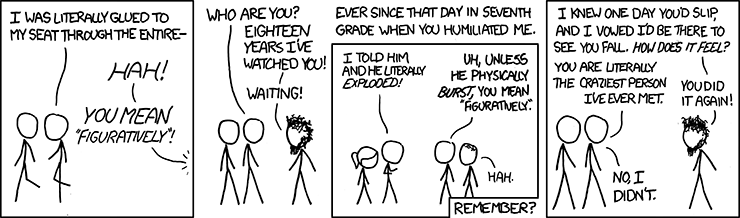
I am pleased to report that AAA has finally stopped running the most irritating commercial ever. They ran this commercial for a long time, and I made a personal promise to myself that no matter what the savings, I will refuse to patronize any company that would run an ad whose first testimonial included a woman looking wide-eyed into the camera and saying "I literally fell out of my chair it was such a big savings."
Literally has lost all meaning and is now used for emphasis, where as before literally means not figuratively. So, this actually happened. In the case of this woman, if she literally fell out of the chair, I want to see the bruises, the hospital bill, etc.
Using literally in this fashion is going to literally make you look like a fool.
Literally is not, repeat, NOT to be used for emphasis. It is used to separate figurative from literal. To separate fantasy from reality.
2. I could care less.
Aww, well shucks. Then you do care! That's so sweet. Here I thought you were trying to break up with me. Wait? What is this you are trying to say?
Oh. You're saying, you don't care. In fact, you are at the bottom of your barrel of caring.
So really, what you meant to say was, "I couldn't care less." In other words, I REALLY do not care. So much so that it is impossible to care any less than I already do. And I obviously do not care.
In other words, stick that little phrase, "than I already do", on the end. See if it still makes sense. If it doesn't, then change it.
Let's go over that again. Ready? I couldn't care less.
3. Quotation marks.
The collective population at some point decided that "quotation marks" should be used for "emphasis" on "signage" and eventually on "blogs."
However, a large portion of us know that if you use them this way, you are actually indicating that you are being facetious.
And if you are making this error, you probably don't know the definition of facetious which is:
Treating serious issues with deliberately inappropriate humor; flippant.
So, if you mark on your menu that you are serving succulent "chicken", it indicates that it is merely some other substance that may taste like chicken which you would prefer to call chicken but certainly is not chicken.
My point? Don't randomly use quotation marks for emphasis. Underline. Circle. Underline and circle. Place in all caps. I don't care. Just stop.
If you want to see fine examples of misuse, feel free to visit this blog later:
http://www.unnecessaryquotes.com/
4. Penultimate.
When this word is used it so often misused that you may not even realize you are misusing it.
The pen of penultimate doesn't mean super, ultra, or beyond. Penultimate actually means next to the top. Poor penultimate is actually the silver medal. It's not quite ultimate. If you reach the penultimate stage of the race, it is next to the last.
Sorry to burst your bubble. This may be your Pluto, and if so I'm truly sorry. But you really have been using this wrong.
5. Addicting
Back in olden times, say twenty years ago, no one said this. Now, it is gaining acceptance and I hear people use this all the time.
Yet really, I'm pretty sure the word you are looking for is addictive.
Addictive is an adjective. It is best suited for descriptions, to describe things.
That television program is addictive.
The "ing" on the end indicates a verb. By some accounts a transitive verb, meaning that you need something more on the end. This is why many of us feel it is wrong usage and it doesn't sound right to our ears. We need something that is missing. Example:
This chocolate cake is such a powerful narcotic, it is addicting me to it.
I'm sure part of our problem is the way we continually try to streamline and shorten. Saying addicting instead of addictive, while helping you sound urban and cool, in written form makes it seem as though you don't know the difference between a verb and an adjective.
Best to be safe, and not make your readers want to throw tomatoes at your blog.
In fact, that is a great motto. Don't make your readers want to throw tomatoes at your blog. It's just common sense.
And if you avoid these errors, I'll keep my own produce in the fridge. I promise.
